Wednesday, June 21, 2023

MAiD - Third Meeting of Aging Gracefully

 The third meeting of Aging Gracefully was held on Tuesday, June 6th at the Senior Activity Centre in West Vancouver, BC.

Our speaker, Paul Magennis, was introduced by Paula Cline. He is the Regional Clinical Educator for the Vancouver Coastal Health Assisted Dying Program often referred to as MAiD. Paul, who has received a Bachelor of Science Degree from the University of Waterloo and a Nursing Degree from UBC, worked in Acute Palliative Care at Burnaby Hospital before his present position at Vancouver General Hospital. He is now  teaching VGH staff the skills and knowledge about medical assistance in dying that they need to support patients as they contemplate their end-of-life care.  


Paul first gave us an overview of how and where MAiD fits into the bigger picture of palliative care (see diagram below) and a brief history including how court challenges resulted in the current legislation concerning medical assistance in dying. He emphasized that we have a constitutional right to choose this option, as long as the eligibility criteria and safeguards have been met. 


Paul was not aware of any current major challenges to medical assistance in dying laws in Canada. The most recent court decisions have resulted in expanded access, such as for those suffering with a mental disorder as their sole underlying medical condition. The implementation of this ruling has yet to take effect as the federal government determined more time was needed to ensure this ruling was met in a safe, equitable, and ethical manner. There are also parliamentary committees that have been discussing the need to consider Advance Directives and the inclusion of mature minors within MAiD legislation. These are not challenges to the existing laws, but rather discussion about how existing laws should be applied to specific groups and situations in the future.   


Conversations and planning regarding palliative care can begin as soon as a person receives a life-limiting diagnosis. Active palliative treatments might not be appropriate at that time, but as a person’s condition and symptoms worsen, palliative care options become more important. We often think of palliative care as end of life care, and while that is a component of it, it is also focusing on symptom management and quality of life at any point in a person’s illness journey. As this diagram illustrates, curative and life prolonging care can and does happen at the same time as palliative care.


How does medical assistance in dying fit into the timeline on the diagram above? While there is no specific time when considering MAiD becomes appropriate—this is a personal choice for the individual when they are considering their illness, disease, or disability, and the level of suffering they are willing to endure as they approach their end of life—medical assistance in dying may fit in with the Life Closure section of this graph, where a person can continue with curative and life prolonging care, and palliative/symptom management, while they also consider and plan for their end of life.  


MAiD is available to people who have a grievous and irremediable medical condition, are in an advanced state of irreversible decline in capability, and that condition is causing enduring physical or psychological suffering that is intolerable to them and cannot be relieved under conditions that they consider acceptable. The legislation does not define what conditions do or do not fit into this eligibility criteria—this is to be determined by the MAiD assessors in consultation with the patient, and in consideration of their full medical history and all dimensions of the person’s suffering. Here is a link for the full eligibility criteria as well as a line for the Model Practice Standards published by The Government of Canada.


Full eligibility criteria:

Medical Assistance in Dying - Province of British Columbia (gov.bc.ca)


Model Practice Standards for Medical Assistance in Dying (MAID):

https://www.canada.ca/en/health-canada/services/medical-assistance-dying/model-practice-standard.html


While there is currently no ability to write an Advance Directive for MAID, there are things you can do now if this is something you would want to consider in the event you have a grievous and irremediable medical condition in the future. You can, and should, have conversations with your family and family doctor about your values and goals in regards to your end-of-life. This may include many things (palliative care, hospice, CPR, intubation, etc.) including your beliefs and values about medical assistance in dying. By knowing your beliefs and values about your end of life, your family doctor will know ahead of time whether and when to have these discussions with you if it becomes appropriate.


If you have been assessed and found eligible for medical assistance in dying, have a Reasonably Foreseeable Natural Death, and are at risk of losing capacity, you may enter into an agreement with your MAiD provider (one of the doctors or nurse practitioners that did your assessment) that will allow them to proceed with your assisted death in the event you lose capacity and are not able to provide consent on the day you scheduled your assisted death. This is called the Waiver of Final Consent. This is different from an Advance Directive. More information on this can be found in the two links provided above.   


Paul emphasized that patients have complete autonomy when it comes to this procedure. You can start, pause, postpone, or stop the process at any time for any reason. (See comment above about the Waiver of Final Consent.)  No one can do it on your behalf. No one can coerce you into applying or decide when you are ready. Only you know your capacity for pain and your desire for a basic quality of life. 


Part of the assessment process is to make sure your request is being made freely, without undue influence from family members, health care providers, or others. The assessors must also be of the opinion that the person requesting MAiD has the capacity to make decisions with respect to MAiD at the time of the MAiD assessment. 


A person may have their assisted death at the location of their choosing, within practical limits. For instance, faith based hospitals, long-term-care sites (LTC), and hospices typically do not allow assisted dying to occur at their locations. This is something to be aware of when selecting an LTC or a hospice site, as a person will be forced to move to another location to have their assisted death. While Paul is not aware of any laws that prevent having a medically assisted death in places like a park or beach, gaining permission for this might be difficult, and these locations do not provide the privacy you would have in your home or hospital room. 


There are a few steps to follow in applying for MAiD. You can call your health authority yourself or you can do this through your doctor or care giver. The phone number for  the Assisted Dying Program at Vancouver Coastal Health is 1(844) 550-5556, or (604) 875-4295 with office hours Monday to Friday, 8am to 4pm.  As well, you can go to vch.ca and search “MAiD”. The Assisted Dying Program Care Coordinators can answer any questions you have and help you access the Request for Medical Assistance in Dying form (which can also be found by Googling “BC MAiD forms").


https://www2.gov.bc.ca/gov/content/health/accessing-health-care/home-community-care/care-options-and-cost/end-of-life-care/medical-assistance-in-dying/forms


If you are found eligible for medical assistance in dying and have met the appropriate safeguards, you may, if you choose, schedule your assisted death. Arrangements will be made with the Assisted Dying Program Care Coordinators and your MAiD provider (one of the doctors or nurse practitioners that did your MAiD assessments). You will discuss with your provider the date and time you would like your assisted death, and whether you would prefer to receive the medication through an IV or an oral liquid. Your provider can discuss the benefits and risks of each of these options. Your provider and at least one nurse will be there to support you and your loved ones at your assisted death.  


There is a booklet available on the website below with current information on this process. If you have questions, or would like more information, please visit the Vancouver Coastal Health MAiD website at vch.ca, and search for “MAiD”. Here you will find resources such as:

  • Frequently Asked Questions
  • The Booklet and Brochure
  • Grief and Bereavement Resources
  • Links to Palliative Support  

https://www.vch.ca/en/service/medical-assistance-dying#resources--73266


Our next meeting will be held in the Fall with our first speaker from VanCity who will explain financial situations during different stages of retirement.

Sunday, June 4, 2023

Art & Archtecture in Ambleside


Pink Palace demolition
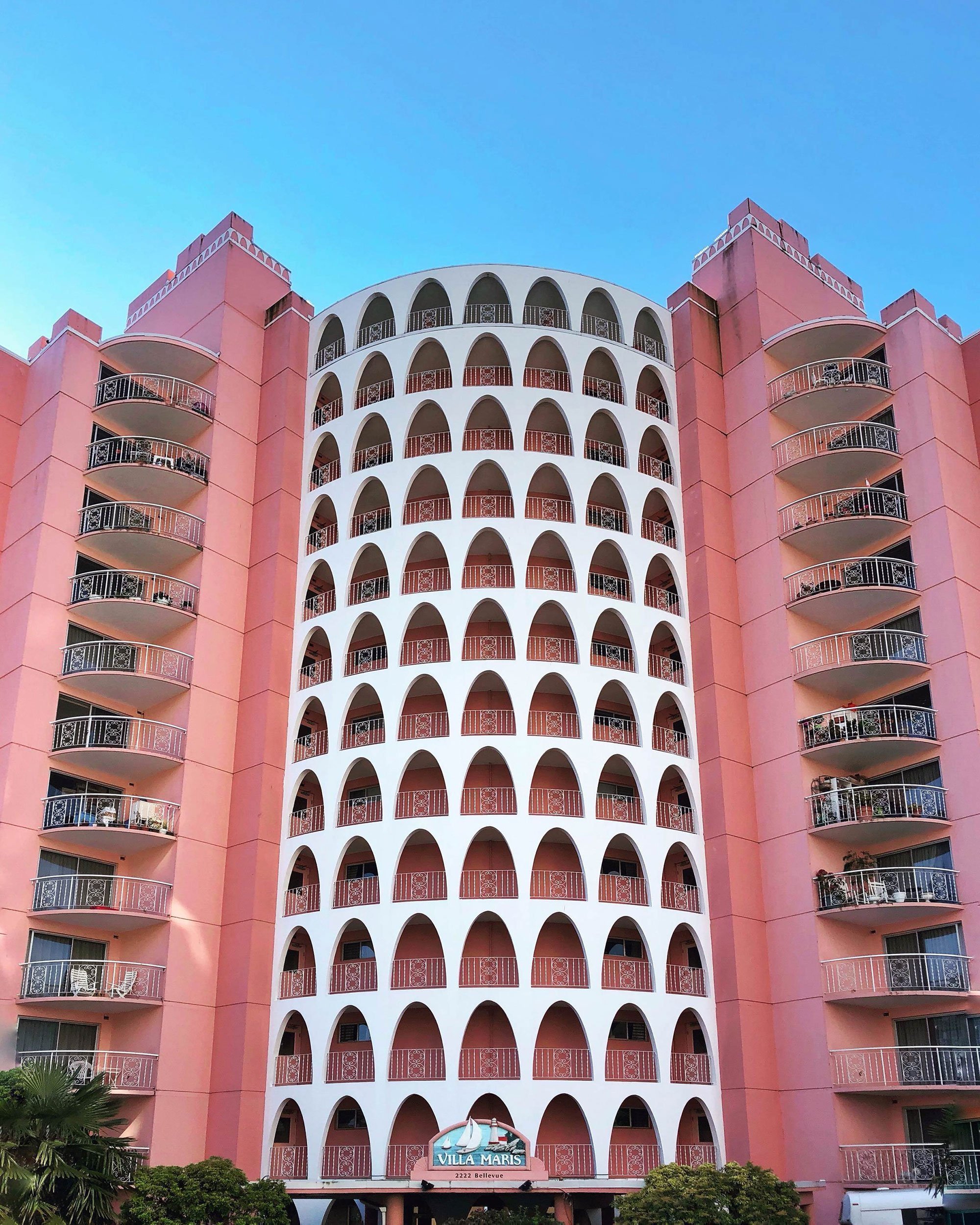
The Villa Marais, better known as the Pink Palace in West Vancouver  Credit: Gralla/Reddit


Art and Architecture in Ambleside intersect continuously in this community. The new Grosvenor building supports this theme with both James Cheng’s West Coast Modern Architecture and the public art of Douglas Copeland, Gordon Smith and Kevin Gould.


https://www.youtube.com/watch?v=y3Twd4hLKT0


We also have heritage houses like the Ferry Building on the waterfront, Gertrude Lawson House at 17th and Esquimalt and two early Craftsman style homes (Rush House and Vinson House) which incorporate these ideas from the past. To this point, the newly refurbished Ferry Building is the home of the North Shore Artists’ Guild and the Gertrude Lawson House is our West Vancouver Art Museum.


In July, the West Vancouver Art Museum is providing an opportunity to experience the architecture of our unique and fascinating  mid-century apartment buildings gracing Argyle and Bellevue Avenues in a walking tour. The apartment buildings in Ambleside, many of which were built in the 1960's, are more than deserving of this special attention.


Tickets are available for twenty dollars for this approximately three kilometer, two hour walk with experienced guides. 

https://westvancouverartmuseum.ca/event/home/inaugural-walking-tour-series-modern-gems-ambleside


Saturday, June 3, 2023

Ambleside Festival Today

West Vancouver Youth Band


Each year, the District hosts a two day multicultural festival in Ambleside Park. You can still attend the second day of this festival today between 11 a.m. and 9:30 p.m. It used to be called the Bridge Festival. This year it is called "The West Vancouver Community Cultural Fest" and includes live music, dance performances, food vendors, a kids’ zone, and cultural pavilions.

Festival Schedule Today 

Saturday, June 3rd (2023)


Main Stage

  • 11:15 am – West Vancouver Youth Band with Bob Baker
  • 12:45 pm – Tiller’s Folly
  • 2:15 pm – Non Sweet
  • 3:30 pm – Hayley Wallis & The Bright Futures
  • 5:00 pm – Bukola
  • 6:30 pm – The Whiskeydicks
  • 8:15 pm – Mostly Marley


West Vancouver Schools’ Stage

  • 11:00 am – Ă‰cole Pauline Johnson Elementary (Grades 6 and 7)
  • 11:55 am – Irwin Park Elementary Bands (Grades 6 and 7)
  • 1:15 pm – West Vancouver Secondary Jr. and Sr. Concert Bands
  • 2:10 pm – Combined Chartwell Elementary and Gleneagles Ch’axy Elementary Intermediate Choir
  • 2:40 pm – Caufeild IDEC Elementary Band (Grades 6 and 7)
  • 3:10 pm – Combined Chartwell Elementary and Gleneagles Ch’axy Elementary Grade 6 and 7 Band
  • 3:40 pm – Sentinel Secondary Grade 8 Concert Band
  • 4:10 pm – Sentinel Secondary Jazz Band
  • 4:40 pm – Sentinel Secondary Rnb Band
  • 5:10 pm – Rockridge Secondary Drumline
  • 5:30 pm – Rockridge Secondary Rock and Metal Band – Nokturna


TD Cultural Dance Stage

  • 11:45 am – Brazilian Swag
  • 12:15 pm – Seymour Dance
  • 12:45 pm – North Shore Academy of Dancing
  • 1:30 pm – Gleneagles Scottish Country Dance Club
  • 2:00 pm – Method of Modern Movement
  • 2:30 pm – Mexico Vivo Folklore
  • 3:15 pm – Dance of Joy Academy
  • 4:30 pm – Dovbush School of Ukrainian Dance
  • 4:45 pm – Southeast Asian Cultural Heritage Society
  • 5:15 pm – Vanleena Dance Academy
  • 6:30 pm – Kitka and Hubavitzi (Bulgarian Dance)
  • 7:00 pm – Sentinel K-dance Crew 

Friday, June 2, 2023

Second Meeting - Aging Gracefully

The second meeting of Aging Gracefully was held on Tuesday, May 2nd at the Senior Activity Centre in West Vancouver, BC.

Paula Cline opened the meeting with a synopsis of the previous meeting and the purpose of Aging Gracefully. She then introduced our speaker – Jeff Palmer – former WVPD Member, now retired, and current Block Watch Coordinator, emphasizing his breadth of knowledge and wealth of experience in dealing with all kinds of fraud and scams.


Although the attendance numbers were low (5 total), Jeff was very gracious and proceeded to give an excellent and comprehensive presentation, which we all appreciated. This also gave us the opportunity to discuss matters in depth, and all attendees had many questions and input.


Given the proliferation and scope of scams, particularly targeting the elderly, there are too many to go into specifics here.  Jeff said he would send a link to Paula (posted below), which he highly recommended, as it would cover many specifics.


General themes in the presentation were:

  • After retirement many people lose touch with resources they had through work. As well,  in general, many older people can become more isolated, leaving them at higher risk of becoming targets of scams.
  • Ways to counteract:  Connection with community; knowledge-sharing,  and being proactive. Be aware that at some point some retirees may need support in decision-making.
  • Today, scammers are more callous, sophisticated and opportunistic than ever.  If you are in doubt about any situation, take that extra step and consult a friend,  a neighbour, your bank, or take time to do some research BEFORE ACTING. Don’t let anyone rush you into a decision.
  • Knowledge and support are key to avoiding getting caught up in these scams. 


Below is the link to the Booklet entitled “The Little Black Book of Scams” 


https://ised-isde.canada.ca/site/competition-bureau-canada/sites/default/files/attachments/2022/CB-LBBS2-EN.pdf


This is a fascinating quick read which covers everything from identity theft to romance scams. It shows you how to recognize scams so that you can avoid them and emphasizes that you can and should report any suspected scams you encounter. 


If you want more information, Jeff can be reached at t: 604-925-7363 | c: 604-785-2446 

www.westvancouverblockwatch.com.


The topic for the  next meeting on June 6th at the Senior Activity Centre will  be - MAiD (Medical Assistance in Dying). We have experts who will explain how this process works in British Columbia. 


When Aging Successfully starts back up in September, we have a Financial Advisor from VanCity who will talk us about how our financial strategies may evolve through various stages of retirement.

Thursday, June 1, 2023

Ambleside Ambiguities


101-588 16th Street, West Vancouver, BC, V7V 3R7

When I moved to Ambleside in 2015 from another Vancouver suburb, I was intrigued by many seemingly odd real estate situations. For instance, in an area that was screaming loudly for more affordable housing, many units in my building, which is and was always affordable, had remained empty for many years. In doing my research I found that some of these empty units had not been put on the market within the past five years. Why would someone willingly pay taxes and maintenance, often amounting to around three percent of the unit value, and continue to pay this amount year after year on an asset that had not maintained its value. 

One answer to this question may be found in Matthew Soules book entitled "Icebergs, Zombies and the Ultra Thin".  His thesis is that since the 1980's, there has been a movement toward "financialization" of real estate. Previous to this, people bought homes primarily to live in or to receive rents from. If real estate values increased in time that was simply a bonus. Since the 80's, people started buying real estate expecting it to act like a stock market commodity. It appears to be a safer way to preserve capital over time. With increasingly unstable areas of the world, many people from other countries have sunk their capital into real estate in safe countries like Canada resulting in many empty homes in my neighbouhood.

Ambleside has a very low tax rate compared to similar communities in the U.S. and Canada. As a result, real estate sales have become the predominant industry in this area. It will be interesting to see how recent legislation such as the empty home tax and restrictions on foreign buyers plays out over time.


MAiD - Third Meeting of Aging Gracefully

  The third meeting of Aging Gracefully was held on Tuesday, June 6th at the Senior Activity Centre in West Vancouver, BC. Our speaker, Paul...